
Do You Need a Tree Removal Permit in Hillsborough County?
In most of Hillsborough County a tree needs a permit before it comes down. The county says a permit is generally required to remove a tree. Your address decides who reviews it: the county, the City of Tampa, or another city.
Which trees need a tree removal permit in Hillsborough County?
Hillsborough County reviews tree permits for addresses outside city limits. Its residential guide covers unincorporated property only. Size and location together decide whether you need a permit.
DBH is the measure the county works from. It means diameter at breast height, taken about 4.5 feet above the ground. For yard and lot trees on a single family property, the county chart starts at 12 inches DBH and larger. Street trees sit in the grassy strip by the road and get treated separately. Those can need a permit at 5 inches DBH and larger.
Some species are exempt no matter the size. The county list includes Brazilian pepper, camphor, chinaberry, Chinese tallow, citrus, mango and queen palm. Trees inside a wetland or water body fall under the Environmental Protection Commission instead. Clearing a whole lot follows a different rule, covered further down. That rule shapes most of our land clearing service in Tampa.
Who issues the tree removal permit for your address?
City limits decide this. Hillsborough County reviews permits only for unincorporated addresses. Property inside Plant City, Tampa or Temple Terrace goes to that city instead. Use the Hillsborough County Property Appraiser to find out which one you are in.
| Jurisdiction | What needs a permit | Who issues it | Where to apply |
|---|---|---|---|
| Unincorporated Hillsborough County | Yard trees from 12 inches DBH, street trees from 5 inches DBH, clearing from 5 inches DBH | Hillsborough County Natural Resources | HillsGovHub portal |
| City of Tampa | Any tree 5 inches DBH or above, invasive species left out | City of Tampa Natural Resources | Tampa Construction Services Division |
| Plant City or Temple Terrace | Set by each city | The city | The city permit office |
| Unincorporated Pinellas County | Healthy trees 4 inches DBH or greater | Pinellas County | Accela permitting system |
| City of St. Petersburg | Shade trees 4 inches DBH or larger | City of St. Petersburg | Building Permit Portal |
| Unincorporated Pasco County | Native trees over 5 inches DBH | Pasco County Building Construction Services | PascoGateway portal |
Thresholds move at every line on that map. A 6 inch oak can sit under the county chart and still need a Tampa permit one street over.
What makes a grand oak or a grand tree different?
Hillsborough County guards grand oaks. A grand oak belongs to the genus Quercus. Its trunk measures at least 34 inches DBH. It also needs a condition rating of good or better. Trunk circumference, height and crown have to total at least 175 points on the county point system.
You must preserve a grand oak unless the county authorizes removal. Once removal is approved, replacement follows the county guides. The City of Tampa runs its own class. Grand trees there are 32 inches DBH or greater, and removal takes special circumstances. It can go to the Variance Review Board or City Council. Public notice comes first. Tampa also wants a permit to prune any tree 24 inches DBH or greater.
When does Florida law let you skip the permit?
Florida Statute 163.045 sets one narrow exemption. A local government may not require a permit, fee or mitigation for the removal. Notice, application and approval are off the table as well. The owner has to hold documentation before the tree comes down. That documentation is an onsite assessment signed by an ISA certified arborist or a Florida licensed landscape architect.
The report has to say the tree poses an unacceptable risk to persons or property. A tree clears that bar only when removal is the one practical way to get its risk below moderate. Residential property means a single family detached building on a lot used for single family purposes.
Tampa reads the limits tightly. A commercially zoned property does not qualify. Neither does a duplex, a townhome or a lot with no residential structure on it. That last one catches a lot of bare parcels. A local government also cannot make you replant that tree. Mangroves stay outside the exemption and under state rules.
Do you need a separate permit to clear the whole lot?
Yes, in unincorporated Hillsborough County. The county defines land alteration as removing vegetation or changing the topography of the land. Grubbing, tree removal, clearing, grading, filling and excavating all count. Clearing means removal of all vegetation including trees 5 inches or greater DBH. Grubbing covers trees under 5 inches DBH pulled out by machine.
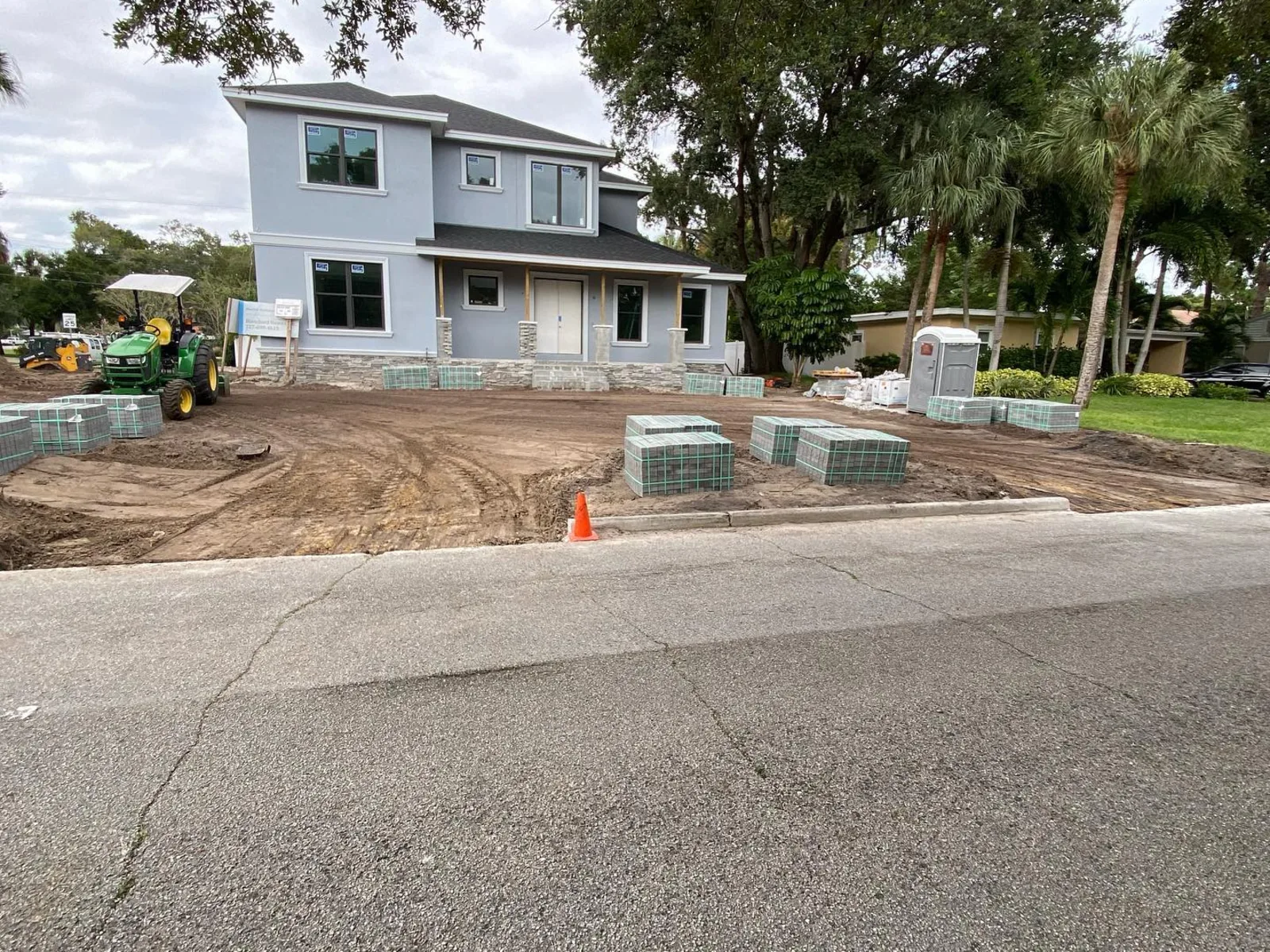
Clearing land to build a home pulls in the Land Alteration and Landscaping permit. You apply for it at the same time as the building permit. The county states you cannot clear the property before you secure that permit. It applies to vacant lots, and to a lot where a home comes down and a new one goes up. That is the usual path after a house teardown. Hillsborough County listed the application fee at $60 in 2026.
Clearing with no construction planned uses the land alteration without construction permit instead. Inside Tampa a construction project works another way. Mark the tree as a removal on the building permit site plan, and no separate tree removal permit is needed. Acre pricing sits in our land clearing cost guide. Site prep before the foundation goes in comes after the lot is clear.
How do you apply, and how long does it take?
- Confirm the address is unincorporated through the Property Appraiser.
- Measure the trunk at 4.5 feet above grade and work out the DBH.
- Draw a site plan to scale with property lines, buildings and the trees.
- Mark the trees you want out with an X, and add photos.
- Sign the authorized agent consent form if a contractor files for you.
- Submit it in the HillsGovHub portal, the only route the county takes.
A homeowner, a tree removal contractor or a certified arborist can obtain the permit. Hillsborough County listed the tree permit fee at $81.65 per parcel in 2025. That covers any number of trees inside the first 5 acres. A county staff member inspects within 15 business days. Results generally land about 3 to 4 weeks after the county receives the application.
An affidavit from an ISA certified arborist drops the field inspection. The county then issues the result in about 5 days. Permits stay valid for a two year period. A denial can be appealed to staff within 30 days.
What happens if a tree comes down without a permit?
Hillsborough County treats it as a code case. If the removal gets reported and investigated with no permit on file, you risk corrective enforcement. That can bring monetary penalties, replanting an equivalent amount of DBH inches, or both.
Tampa calls removal of a protected tree without a permit an irreparable or irreversible violation, which can carry fines. Pinellas County can require an after-the-fact permit, mitigation, penalties, or a mix of those. Anyone can search a property address on the HillsGovHub portal with no account, so a missing permit is easy to find.
How do Pinellas, St. Petersburg and Pasco differ?
Unincorporated Pinellas County uses a Tree Removal or Habitat Permit on private property. Healthy trees 4 inches DBH or greater are protected. New rules took effect on Jan. 23, 2026. On homesteaded, actively occupied single family property, only trees greater than 24 inches DBH count as protected now. Staff usually inspect within one to two business days.
St. Petersburg protects any shade tree 4 inches or larger DBH. Its grand class starts at 30 inches DBH, with laurel oaks left out. Tree removal permits there stay valid for 6 months. The city honors the state exemption when the paperwork holds up.
Unincorporated Pasco County wants a permit for native trees over 5 inches DBH. Non-native trees are exempt, and so are palms and pines apart from longleaf pine. Every Pasco tree permit starts with an automatic replant. Pasco has no lot clearing permit of any kind. A bare parcel needs an assigned address and a site development permit first. Review runs 3 to 4 business days. Wesley Chapel sits in that county.